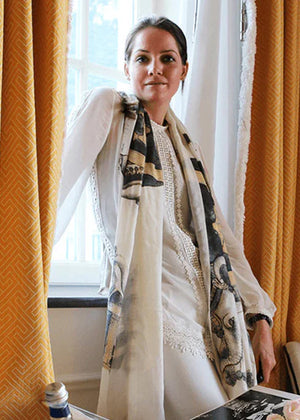
T H E C A S H M E R E S T O R Y
What is cashmere?
Cashmere, one of the finest natural fibres known to man, evokes images of soft, delicate luxury combining the apparent paradox of warmth and lightness.
Originating in Kashmir, high in the mountains of the Himalayas, cashmere is known by its authentic name, pashmina. The word pashmina is much misused, today being adopted to describe shawls and scarves of various mixes of wool, silk, cashmere, and even polyester.

But real pashmina, from the word pashm, means king’s fabric, the name for only the finest 100% cashmere, and it has been prized for centuries. Pashmina shawls first found their way to the courts of the Roman Emperors and were later popularised in Europe by Empress Eugenie, wife of Napoleon III, a leader of world fashion in the 19th century, who is credited with introducing cashmere to the western world.
Pashmina or cashmere is the soft downy inner fleece of the Kashmir goat. To withstand the extremes of temperature in the mountains, dry arid summers and freezing winters, the animals grow two coats, the outer one hard and wiry and the inner one soft and luxurious.
How is it produced?
In springtime, the goats start to moult and it is then that the soft fibre is combed away by hand, each animal producing just a few ounces of hair. Combing the goats and collecting the fibre is a family occasion. No harm is done to the goats.
Turning the fibre into cloth is a difficult process and adds to the mystique of the cashmere. The inner and outer coats have to be separated before the fine fibre can be spun and woven. This requires immense skill.
The physical properties of pashmina, or cashmere, explain its exclusivity and desirability. The fibre is so fine, at least six times finer than a human hair, and measures about 11 microns (11/1000 of a millimetre). When the fibres are twisted together during the spinning process, thousands of microscopic air pockets form which give cashmere its superb insulation and weightlessness.
It takes the annual output of three to four goats to produce one cashmere shawl. Put another way, so fine is the fabric that one hand spun, hand woven scarf uses 1.5km of this precious fibre, yet weighs less than 75grams.
Traditionally in Kashmir the spinning and weaving is done by hand, the women spin and the men weave, whilst most other cashmere is now produced by machine. At Black we have cashmere using both methods.
The Ring Shawl
The finest and most exclusive of all is the Ring Shawl, the jewel in the cashmere crown.
Hand spun and hand woven because the fibre is so fine that machine weaving would break it, each shawl, taking around 200 hours to produce, is individually made in Kashmir using long established skills and craftsmanship which have been handed down from generation to generation. Each one is discreetly signed by the person who made it.
The Ring Shawls are so fine that, even a large shawl measuring 200cm x 100cm will pass through a woman’s wedding ring. Hence the term ‘Ring Shawl,’ used to define the very finest cashmere.
Woven and Knitted Cashmere
Our machine woven and knitted cashmere are produced in the UK in Scotland and Yorkshire using high quality cashmere, selected with care using skills developed over generations.

Both regions are steeped in the woollen industry and both benefit from soft local water which enables the delicate fibre to be gently washed without the addition of artificial soaps or other agents. This significantly improves the handling and finish of the cashmere.
The Ring Shawls
Our hand spun, hand woven Ring Shawls are produced in the war-torn disputed region of Kashmir. It is a poor area which has suffered from the long and unresolved conflict between India and Pakistan and more recently from the devastation caused by the earthquake in the autumn of 2005.
Despite the poverty and difficulties the region is rich in the long-established skills and dedicated craftsmanship which are so worthy of being preserved but which have come under pressure as cheaper products of inferior quality have entered the market.
Black’s hand spun, hand woven Ring Shawls as well as many of our pure silk scarves and shawls are produced by a company which provides work for over 400 families, 200 of which they directly look after.
By championing this most exclusive of fabrics in this way we hope to help support the people of Kashmir and to do what we can to ensure that the art of producing such exquisite items is preserved for generations to come.
UK Manufacturers
Closer to home by supporting British manufacturers with long established skills and expertise in producing excellent quality cashmere we hope to help preserve these traditions again against the plethora of cheap imports which may threaten the survival of these skills.
Caring for cashmere
Cashmere is one of the finest natural fibres in the world and whilst this wonderfully delicate fibre is luxurious to wear it does require a little more care and attention than other fibres. After wearing your cashmere for the first few times you may find small balls of fibre forming on the surface. These small balls or ‘pills’ are caused by some of the loose fibre tangling together as areas are rubbed together during wear. Pills can be easily removed by hand or by using a cashmere comb.
After lavishing a little care and attention on your cashmere and removing the ‘pills’ in this way, of it will actually consolidate and soften in handling and touch. We recommend that you follow the care instructions and that all of the Black cashmere range should be dry cleaned only.
We hope that you will enjoy the luxury cashmere and the range offered by us.
|